The use of medicinal cannabis is increasingly common in the community, with individuals often seeking access to this treatment outside their usual healthcare arrangements, including through online medicinal cannabis clinics.
Many clinicians and patients remain unclear about the impairing effects of medicinal cannabis, and the potential interactions with other medicines and impairing substances. There is also uncertainty about the laws relating to medicinal cannabis and driving in Victoria.
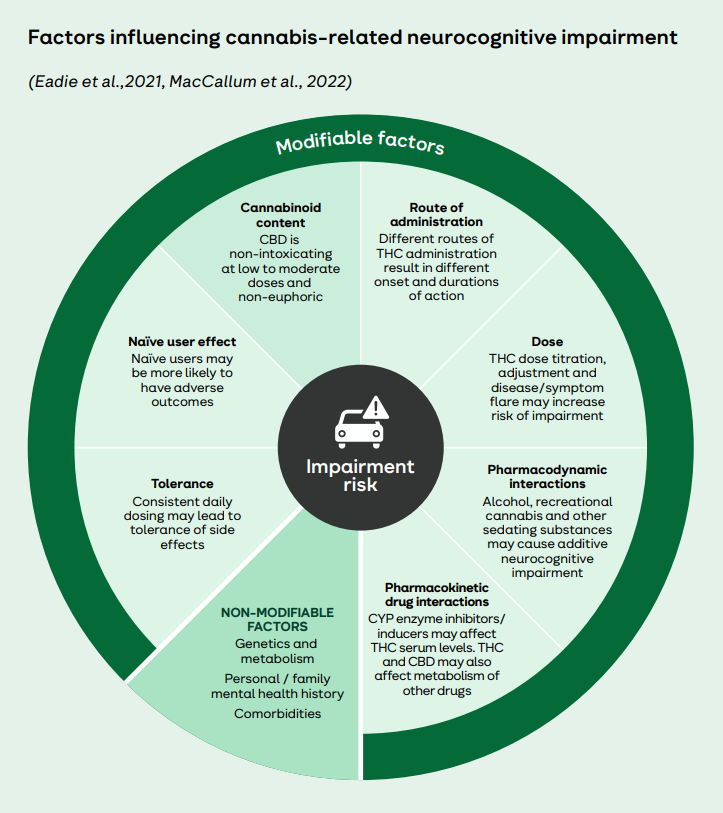
Medicinal cannabis products vary widely, with many containing the impairing cannabinoid ∆-9 THC (delta-9-tetrahydrocannabinol) as well as the non-impairing CBD (cannabidiol) in varying proportions. THC has been shown to impair the cognitive function and motor coordination needed for safe driving, particularly in the first few hours following consumption. These effects can impair a driver’s ability to:
- anticipate hazards and unexpected situations and respond accordingly
- divide their attention to manage the driving task
- make appropriate decisions and respond quickly to changes in the road environment.
In addition to the direct impairing effects:
- THC may add to the neurocognitive effects of other sedating substances.
- The impairing effects of THC may be increased by drugs that affect cytochrome P450 metabolism.
- Both THC and CBD can interact with these enzymes and may increase or decrease levels of other drugs.
The impairing effects and other interactions are highly individualised and depend on the dose of THC, the formulation and the method of administration, as well as the individual’s metabolism and comorbidities.
Managing the risks
Prescription drugs represent a significant road safety risk, being involved in about 21 per cent of fatal road collisions in Victoria between 2007 and 2013.1 In addition, between 2018 and 2022, 15 per cent of fatally injured drivers in this state were found to have THC in their system, acknowledging that medicinal use cannot be differentiated from recreational use in these findings.2 Furthermore, a survey of medicinal cannabis users conducted in 2020 found that 28 per cent had driven while impaired (driving under the influence) in the 12 months leading up to the survey.3
Responding to these risks, and acknowledging the important role of health professionals in educating and managing patients in relation to health and driving, Transport Victoria has developed a suite of resources, including:
- A decision support resource that provides detailed information to support assessment and management of impairment risk and links to additional information and references.
- A driving needs checklist that guides the clinician’s assessment of a patient’s driving requirements to support conversations about driving and inform prescribing and management decisions. It can also provide evidence that the conversation about driving has occurred.
- A patient factsheet that facilitates conversations about driving risks and legal obligations in relation to medicinal cannabis, noting that it is an offence in Victoria for a person to drive with any detectable amount of THC in their system.
- A consumer-facing poster that highlights the road safety risks and drug driving laws, urging readers to talk to their treating health professional and download the Factsheet. This is a valuable resource for waiting areas.
The resources are available on the Transport Victoria website.
For more information:
- Drug interactions: The CANNabinoid Drug Interaction Review (CANN-DIR™) is a free web-based platform that has been developed to screen for potential drug-drug interactions from the perspective of how a cannabinoid delta-9-tetrahydrocannabinol (THC), CBD, or a combination of THC/CBD may affect the metabolism of other medications.
- Reporting medical conditions to the Department of Transport & Planning Victoria: See the Transport Victoria website for information about requirements for reporting medical conditions that may impact driving.
- Fitness to drive: Assessing Fitness to Drive 2022 – the national standards now include general guidance about driving and medicinal cannabis.
- Roadside testing: For more information about roadside testing and penalties for drug-driving follow this link: Drug-driving penalties: Transport Victoria.
References:
- Olaf H. Drummer, Suwan Yap, The involvement of prescribed drugs in road trauma, Forensic Science International, Volume 265, 2016, Pages 17-21, ISSN 0379-0738, https://doi.org/10.1016/j.forsciint.2015.12.050
- Department of Transport and Planning, Victoria. Road Trauma in Victoria – 2024 Statistical Summary, Page 47 https://www.vic.gov.au/sites/default/files/2025-08/Road-Trauma-in-Victoria-2024-Summary.pdf
- Arkell, T. R., Abelev, S. V., Mills, L., Suraev, A., Arnold, J. C., Lintzeris, N. and McGregor, I. S. (2023) ‘Driving-related behaviors, attitudes, and perceptions among Australian medical cannabis users: results from the CAMS 20 survey’, J Cannabis Res, 5(1), pp. 35 https://link.springer.com/article/10.1186/s42238-023-00202-y
Disclaimer: This article was provided by Transport Victoria. While every effort has been made to ensure the information is accurate, North Western Melbourne Primary Health Network does not warrant or represent the accuracy, currency and completeness of any information or material included within.