With the respiratory illness season approaching, now is the time to prepare your practice and proactively invite priority patients for influenza vaccination.
ATAGI recommends annual influenza vaccination for everyone aged six months and over, as soon as possible after vaccines become available, and ideally before winter.
Online ordering for influenza vaccine via Onelink opened on 31 March 2026, with weekly ordering available throughout winter.
All influenza vaccines available in Australia in 2026 are trivalent, comprising two A strains and one B. Recent vaccines have been quadrivalent, but the World Health Organisation has now recommended removing the B/Yamagata lineage because it has not circulated for several years.
Co-administration is safe with other vaccines, including those for COVID-19.
Vaccination is still recommended following a recent influenza infection.
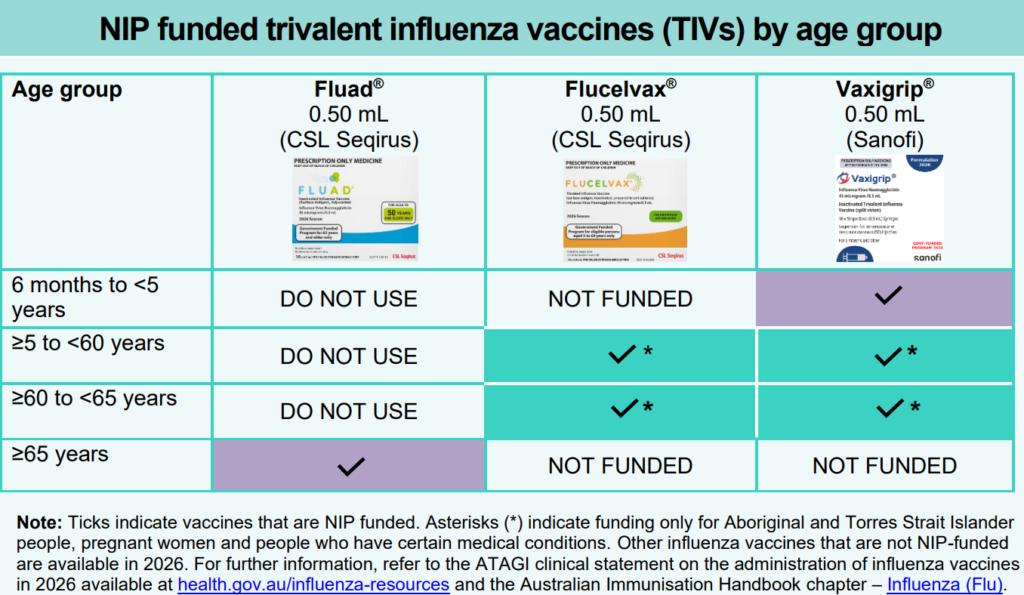
This table shows vaccines available in 2026 for specific age groups.
Intranasal live attenuated influenza vaccine LAIV; FluMist® for children aged two to 17 is available in Australia for the first time through the private market only in Victoria and via selected state programs in NSW, QLD, SA, and WA.
Vaccine providers should advise patients that the FluMist nasal vaccine contains hydrolysed gelatine derived from pig products. Further information can be found in the manufacturer’s Australian product information.
Priority groups: quick actions that lift uptake
Children (six months to under five years)
- Offer influenza vaccination during routine child health checks and alongside scheduled childhood immunisations.
- If it is the child’s first ever flu vaccine, check if a second dose is needed. Healthy children aged six months to two years or children under nine who have a medical at risk condition receiving influenza vaccine for the first time are recommended two doses given at least four weeks apart.
- Healthy children aged over two years need one dose every year, regardless of whether they have ever had one before.
Pregnant women
- Offer influenza vaccination in every pregnancy, at any stage of pregnancy.
- Use inactivated influenza vaccines. LAIV should not be used.
Aboriginal and Torres Strait Islander people
- Use culturally safe, flexible access options such as walk‑ins or extended hours, and bundle opportunistically with other preventive care.
- Ensure practice systems support respectful identification and recall for NIP eligibility.
Medically at‑risk patients aged six months to 64 years
- Use clinical software prompts and chronic disease registers to identify eligible patients and offer vaccination at reviews and care‑plan visits.
- Consider a ‘respiratory protection’ offer: flu plus COVID-19 (if due) in one visit.
Adults aged 65 and over
- Recall early and offer opportunistically at every touchpoint (repeat prescriptions, care plan reviews, annual health assessments).
When patients are hesitant: keep it simple
Many people have questions — especially parents of young children and patients considering co‑administration. A calm, respectful conversation plus a clear recommendation is often the most effective approach.
You can find specific resources to support health professionals in having conversations about vaccine hesitance on the National Centre for Immunisation Research and Surveillance SKAI website.
If you need support, contact the NWMPHN primary health care improvement team on primarycare@nwmphn.org.au or (03) 9347 1188.
Resources
- Influenza pathway | HealthPathways Melbourne
- Statement on seasonal influenza vaccines in 2026 (.pdf) | Australian Technical Advisory Group on Immunisation (ATAGI)
- 2026 influenza vaccination: Program advice for health professionals (.pdf) | National Immunisation Program
- 2026 seasonal influenza vaccines: Information for consumers and health professionals | Therapeutic Goods Administration
- Communication tools for vaccine conversations | Sharing Knowledge About Immunisation
- Webinar: Seasonal respiratory diseases – Immunisation annual update (26 March 2026) | NWMPHN