In Melbourne’s west there are communities experiencing deep disadvantage. The impacts of sporadic, sometimes absent, income are compounded by language barriers and the intergenerational effects of past trauma and violence.
For some in these communities, seeking health care can be a fraught process. Understanding how the system operates can be challenging. Even though, thanks to Medicare, many services are free or low-cost, for others expense is still a powerful disincentive. Simple access – defined by location, or transport, or language – can be nigh on impossible.
This reality impacts children the hardest. Findings from North Western Melbourne Primary Health Network (NWMPHN) health needs assessments found that within these communities access to care for young people affected by chronic or neurodevelopmental conditions was especially challenging.
Parents – previously traumatised by strangers in uniforms, here or overseas – are often reluctant to engage with specialists in hospital clinics, and sometimes find even travelling to them almost impossible.
Recognising these hurdles, NWMPHN commissioned Werribee Mercy Hospital to deliver a program called Working Together for Kids. Essentially, the program places paediatricians into primary schools – facilitating direct access to care.
“You have to try to build trust with great sensitivity, open curiosity, and patience,” says participating paediatrician Dr Raffaela Armiento.
“And I think you need an inherent respect for the children and families and the communities from which they come. It’s slowly-slowly. There’s no race.”
Working Together for Kids aims to improve the physical and mental health of children experiencing social, economic or health disadvantage and who do not typically have timely access to paediatric services. It can also serve as a referral conduit into allied health, general practice and other medical specialties, to establish connections and pathways for routine and ongoing primary care.
Trust here is critical. And so is proximity.
Working Together for Kids is delivered through community hubs located at Truganina South Primary School, Doherty’s Creek College, also in Truganina, and Wyndham Park Primary School.
“We work in the community hubs, which are put there to help integrate multicultural families into the communities and give them services,” explained Dr Kathy McMahon, Director of Paediatrics at Mercy and the principal designer of the program.
“They are well placed to provide access to paediatric care.
“A lot of these families have quite complex needs – and so do their children, but we found they frequently were not seeing any paediatricians. There were many reasons for this. It might be because of poor health literacy, or because they couldn’t afford it financially. It might even be, in some cases, they don’t want to find out if their child has got an issue because that can be regarded as a source of shame.”
And there were issues of trust and uncertainty, as always. Dr McMahon observed that parents and children from some communities often missed appointments at hospital clinics.
“So we thought working together on site at the primary schools would give them timely access,” she explains.
“We’d work in a coordinated way with the teachers, the community hub leaders, any allied health involved. Coordinating care at the school site means we’re all on the same page. And we’re all ready to learn from each other – so it’s a really collaborative system.”
The Working Together for Kids program – loosely based on an earlier project Dr McMahon delivered in Frankston – kicked off in June 2022.
Each school community hub hosts a paediatrician and a second clinician one day a week. The program is funded by NWMPHN at $799,500 across four years.
The clinicians become trusted members of the school communities, and are able to manage onward referrals, primarily for autism assessments, occupational therapy, speech therapy and audiology tests. They can also connect young patients, and their families, into general practices for routine care and support.
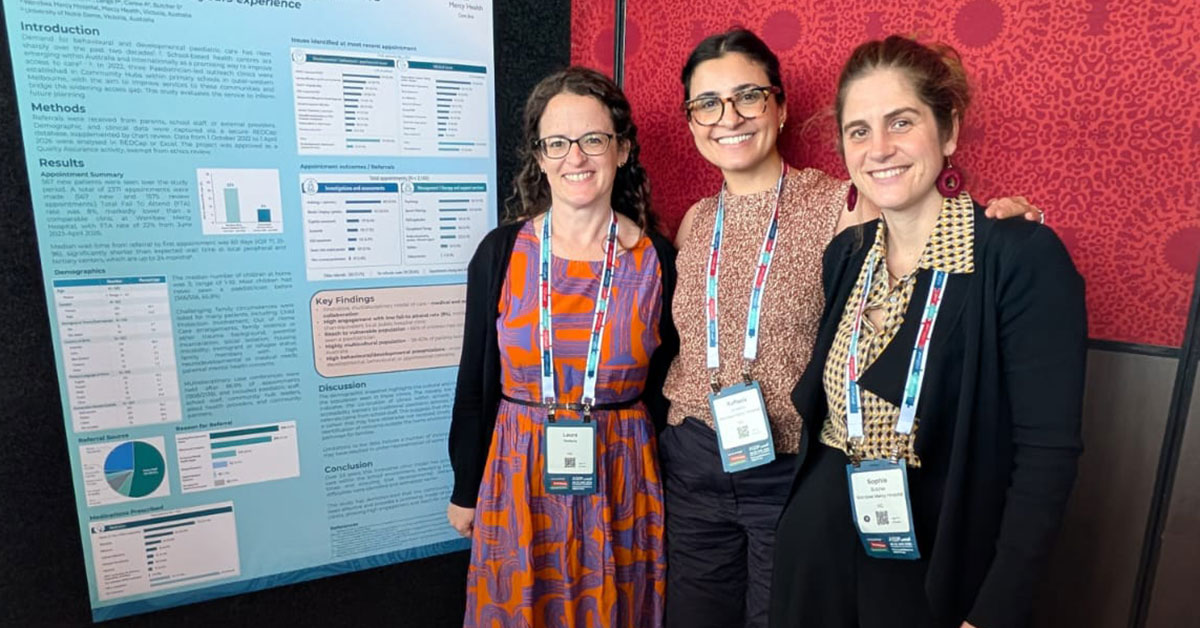
“It’s so complex,” says Dr Sophie Butcher, a paediatrician who job-shares with Dr Armiento at Wyndham Park.
“This work is about making a meaningful difference for families, many of whom come from highly complex backgrounds. The challenges children experience are often shaped by the broader environmental stressors in their lives, and addressing these effectively requires a collaborative, team-based approach.
“That’s ultimately why our clinic has been able to support some of the most vulnerable families, often when other services have struggled.
“We’re not paediatricians working in isolation. Instead, we work closely with school staff, including teachers, assistant principals, wellbeing teams and community hub coordinators, to support both the child and their family in a holistic way.
“This team-based approach is central to what we do, and it makes all the difference.”
And as each difference is made, trust grows.
“I think that’s other thing – there’s a lot of word of mouth,” says Dr Butcher.
“All the families know each other. Wyndham Park Primary is not a particularly big school. They all know each other and they all talk. So if one family says ‘Oh we liked the paediatrician,’ then that will enable another family to have the courage to come to the appointment.”
And so far the numbers are good. By the close of March, 2026, the Working Together for Kids program had supported over 600 children, delivered more than 2,000 appointments, made over 2,100 referrals to vital services and held 1,800 case conferences bringing together educators, clinicians and families.
Common conditions include neurodevelopmental issues and neurodiversity as well as chronic and acute physical health matters.
The number of consultations certainly tell a good story, but there is another number that tells an even better one. At the Mercy’s paediatric outpatient clinics, quite a lot of people do not turn up for scheduled appointments. At the primary schools, failure to attend is almost unknown.
“We don’t realise that some of these families don’t have a second car, or even a first car,” says Dr McMahon.
“They might have eight kids. They might need to catch two buses and a train to get to an outpatient appointment. We don’t recognise often the barriers that they have to engaging with health care. So having it on site where the children do go to school – it’s within their community, so they’re much more able to access us.”
For the communities of Wyndham and Truganina, access to health care has gradually become easier over the past two years.
Boosted funding to Medicare and other initiatives implemented by the Australian Government have seen a surge in general practices converting to full bulk-billing models. Medicare Urgent Care Clinics and the 2026 opening of a dedicated endometriosis and pelvic pain clinic in Werribee have also extended care availability.
“Overall, it’s getting easier to see GPs and other primary care services,” says NWMPHN chief executive Christopher Carter.
“The Working Together for Kids program has been an important factor in providing specialist care to communities which can sometimes be difficult to reach.
“NWMPHN is keen to work with the team at Mercy to strengthen the prototype, in particular looking at building referral pathways with general practices in the area.”
The program presents a strong example of holistic, multidisciplinary care.
It’s also a great example of clear-eyed expectations.
“Success for me is alignment with the families, so identifying their priority areas and reaching shared goals for their child,” says Dr Armiento.
“So if they are feeling like they’ve had a win, then that’s a win for me. Holding on to a family who would otherwise be disengaged from services, that’s a win.”
Working Together for Kids has been made possible through funding provided by the Australian Government under the PHN Program.